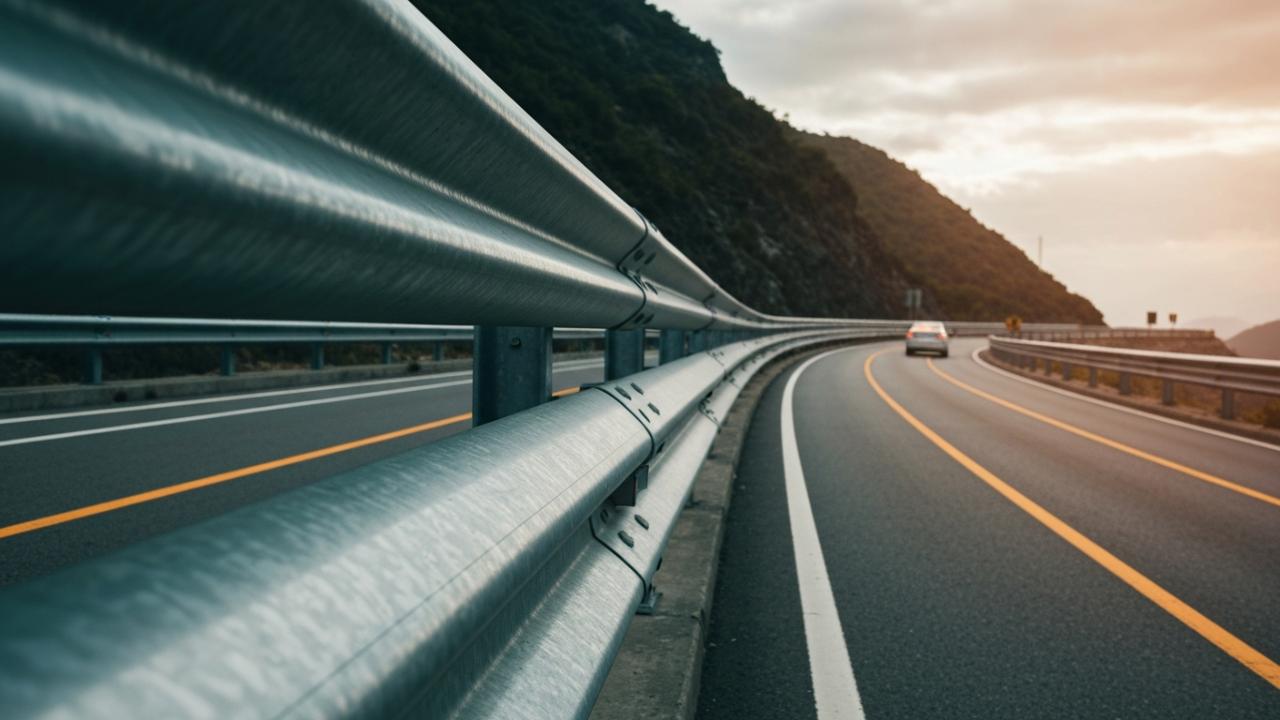
Honestly, when we’re driving, we often just pass by the guard rails lining the road without a second thought, don’t we? I used to do that too. I just thought, ‘Oh, they’ll stop me if I get into an accident,’ and didn’t really know how important their role was. But did you hear the news about the tragic accident in Gyeongju on April 11th, where a car hit a guard rail, fell 5 meters, and 4 people died? After hearing that, I started to realize just how crucial guard rails are.
They might look like simple steel structures, but in reality, these guys are vital safety guardians directly connected to our lives. Today, I’d like to share some hidden stories about guard rails that we might not have known. They’re much smarter and more reliable than you’d think.
The True Role of Guard Rails, Different from Their Appearance

Usually, when we think of guard rails, we only imagine them preventing vehicles from leaving the road, right? Of course, that’s their biggest role. But did you know that’s not all? According to Namuwiki, guard rails also fundamentally prevent secondary accidents that can occur when a vehicle leaves the road, absorb impact to minimize passenger injury and vehicle damage. They even play a role in restoring a colliding vehicle back to its normal direction of travel, making them quite versatile, aren’t they?
- Preventing Road Departure: They are the primary safety net that prevents vehicles from leaving the lane.
- Impact Absorption and Damage Minimization: In a collision, they disperse and absorb impact to reduce passenger injury and vehicle damage.
- Vehicle Direction Restoration: They can also guide a vehicle back to the road safely after a collision.
- Visual Guidance: Even without an accident, their function of naturally guiding the driver’s gaze to aid driving convenience cannot be ignored.
In movies and games, guard rails are often depicted as easily breaking when hit, aren’t they? But in reality, unless it’s shoddy construction, actual guard rails are strong enough that most passenger cars won’t even budge them. They say it takes a large SUV or bus to cause damage, meaning they’re much tougher than you’d think.
The Evolution of Guard Rails for Safer Roads

Guard rails are estimated to have first appeared in Korea in the mid-1960s. Longer history than you might think, right? However, it wasn’t until 2001 that Ministry of Land guidelines, which passed crash tests, were established, and even then, actual implementation was delayed until a nationwide replacement effort began after the Incheon Bridge multi-collision incident in 2010. This is when the importance of guard rails became more prominent.
Currently, various grades of guard rails are installed depending on the road’s design speed and risk level. They are divided into 9 grades from SB2 to SB7 based on impact resistance and design speed, with higher-grade guard rails installed on expressways or dangerous sections. Research is also actively underway to develop impact-absorbing guard rails that go beyond simply blocking to absorb impact more effectively. They’re not just using simple steel plates like in the past; they’re continuously evolving.
- Various Grades: Installed in various grades, such as SB2~SB7, tailored to road characteristics and risk levels.
- Impact Mitigation Technology: Guard rails with enhanced impact absorption capabilities are being developed to reduce passenger injury and vehicle damage during collisions.
- Strengthened Domestic Standards: Moving away from past inadequate management, nationwide replacement and strengthening of safety standards occurred after the Incheon Bridge accident.
Guard Rails Beyond Roads, Even on Railways?

When you think of guard rails, you usually only imagine those installed on the side of the road, right? But did you know that guard rails are also installed on railways? Railway guard rails are installed to prevent train derailments, or to prevent the worst-case scenario of a major accident even if a derailment occurs. They exist with different purposes and forms than road guard rails.
They are mainly installed in sharp curve sections or turnouts (where tracks divide) where derailment is highly likely, guiding trains to stay on the tracks. Also, in sections where massive damage is feared if a train overturns, such as railway bridges or tunnels, guard rails for ‘overturn prevention,’ known as check rails, are sometimes installed. They say that if these are present, even if a partial derailment occurs, it can prevent the entire train from overturning at once, which is truly reassuring, isn’t it? To think they were protecting our safety in unexpected places, doesn’t it just make you want to say, ‘I wish I could freeze-dry them’? I’m sure I’m not the only one who feels like preserving these important safety devices as they are.
Isn’t it amazing that the guard rails we pass by every day have such diverse functions and history? We thought they were just structures on the side, but in fact, they are important safety nets in our lives, embodying countless technologies and efforts.
From now on, when I see guard rails on the road, I think they’ll appear not just as fleeting scenery, but as reliable friends silently protecting all our safety. I hope there will be greater interest in all safety facilities that protect us in unseen ways.