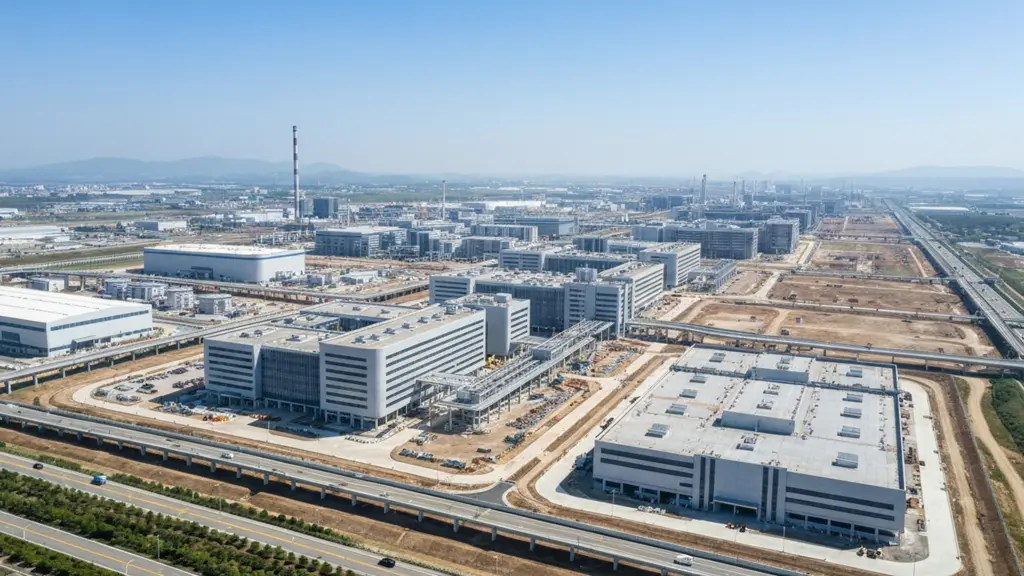
One of the hottest news items in the semiconductor industry recently is the significant acceleration of the operational timeline for Samsung Electronics’ first production facility (fab) within the Yongin Semiconductor Cluster. The initial target for the first fab’s operation, originally anticipated for 2030-2031, has been moved up by 1-2 years to 2029. This accelerated schedule is expected to have considerable ripple effects not only on the domestic semiconductor ecosystem but also on the global market. Let’s delve into the background behind this decision and the changes it is expected to bring.
Explosive Growth in AI Semiconductor Demand: Key Driver for Early Operation

As global competition in artificial intelligence (AI) technology intensifies, the demand for AI semiconductors is truly exploding. The primary reason Samsung Electronics is rushing the operation of its first fab in the Yongin Semiconductor Cluster is precisely to proactively respond to this AI semiconductor market. Industry estimates suggest that the memory semiconductor market size in the second quarter of this year will reach 350 trillion won, a 380% increase year-on-year. Amidst these market trends, Samsung Electronics’ strategy is to rapidly expand its production capacity to swiftly meet the surging demand for AI semiconductors and maintain a super-gap in the global semiconductor hegemony competition.
Government’s Full Support and Mega-Project Review Meeting

Samsung Electronics’ push for early operation is also closely aligned with the strong will of the government. The government is fully supporting the early development of the Yongin National Industrial Complex, accelerating the overall project schedule. Notably, it is known that the early operation schedule for the Yongin Semiconductor Cluster was discussed in depth at the ‘Public-Private Joint Review Meeting for Mega Projects’ chaired by the President on July 6th. The government’s active involvement is expected to greatly facilitate the swift progression of complex procedures such as site preparation, land compensation, expropriation decisions, and contractor selection. There are also observations that the timelines for supplying core infrastructure, including electricity and water, could be brought forward.
Essential Prerequisites for 2029 Operation

For the first fab to commence operations in 2029, several prerequisites must proceed smoothly. The main procedures are as follows:
- Site Preparation Work: Must begin by the second half of this year at the latest.
- Fab Construction Commencement: Groundbreaking must occur by 2027.
- Infrastructure Establishment: The early construction of a 3-gigawatt (GW) liquefied natural gas (LNG) power plant and phased electricity and water supply plans must be implemented without a hitch.
Considering that the construction of a state-of-the-art semiconductor factory typically takes about two years, rapid progress at each stage is crucial. If these efforts proceed as planned, the development of the domestic semiconductor materials, parts, and equipment (SoBuJang) ecosystem is also expected to gain momentum faster than anticipated.
The early operation of the first fab in the Yongin Semiconductor Cluster will be a crucial turning point for changes in the global semiconductor market and the enhancement of national competitiveness. With Samsung Electronics’ aggressive investment and the government’s full support creating synergy to seize leadership in the AI era, the Yongin Semiconductor Cluster is expected to quickly establish itself as a key hub illuminating the future of South Korea’s semiconductor industry.