
aircraft predictive maintenance Aircraft Predictive Maintenance Aircraft, soaring through the skies, have always been the epitome of advanced technology. But just as crucial as technological advancement is ‘safety.’ Aircraft maintenance, in particular, is directly linked to passenger lives, so its importance cannot be overstated. Recently, the aviation industry has been grappling with unpredictable variables, and in this situation, Korean Air has taken a proactive step.
From April 22nd to 23rd, the airline hosted the ‘2026 Predictive Maintenance Global Airline Workshop’ at its headquarters in Gangseo-gu, Seoul. This marks the first time an airline, as an operator rather than an aircraft manufacturer, has hosted such a large-scale international workshop. The fact that over 70 maintenance experts from 20 major airlines worldwide gathered to discuss the future of aviation safety is proof that Korean Air is demonstrating strong leadership in this field.
Predictive Maintenance: Technological Innovation Beyond Simple Repairs

So, what exactly is aircraft predictive maintenance? It’s a cutting-edge maintenance method that goes beyond simple fault repair, predicting failures before they occur and taking proactive measures. It involves analyzing vast amounts of big data, including flight data, to predict when a component might fail, and then replacing or repairing it before a problem arises.
- Enhanced Safety: It maximizes the safety of aircraft operations by preventing unexpected failures in advance. This is crucial for both passengers and crew.
- Increased Operational Efficiency: By reducing unnecessary maintenance and intervening precisely when needed, it can significantly cut down on maintenance time and costs. This plays a key role in reducing flight delays and cancellations.
- Lifecycle Management: It allows for efficient management of aircraft asset lifecycles by optimizing replacement cycles based on the actual condition of components.
In fact, this technology has become an essential element for the survival of airlines. In a complex external environment, data-driven prediction has become a necessity, not an option.
Korean Air Sets a New Standard for the Global Aviation Industry
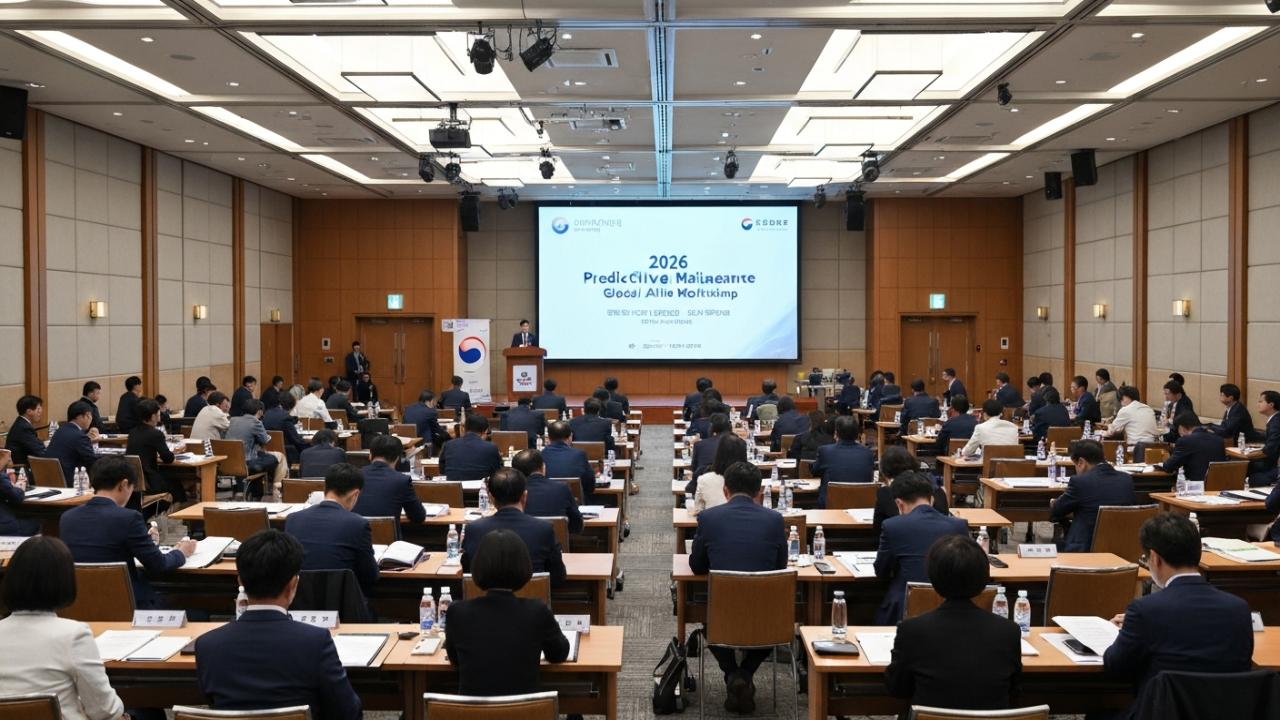
What makes this workshop even more significant is that Korean Air, as an ‘operating airline’ rather than an aircraft manufacturer, hosted the event. While predictive maintenance technology development has primarily been led by manufacturers, airlines ultimately possess and can analyze the most actual flight data. Based on this strength, Korean Air shared its know-how with global airlines, setting a new standard.
- Platform for Collaboration: Maintenance experts from 20 major airlines worldwide, including Delta Air Lines, United Airlines, All Nippon Airways (ANA), and Swiss International Air Lines, participated to share their predictive maintenance operations and big data utilization strategies. This will lead to industry-wide advancement beyond the capabilities of individual airlines.
- On-site Tour Opportunity: Participants directly visited Korean Air’s Incheon Engine Test Cell (ETC) and Flight Training Center to observe actual maintenance sites. Seeing real-world applications beyond theory must have provided significant inspiration for technological development.
- Proactive Leadership: Yoo Jong-seok, Korean Air’s Senior Vice President and Head of Operations & Safety and Security, emphasized in his keynote speech, “We must build strong partnerships among global airlines to make the aviation industry safer and more efficient.” This demonstrates a vision for the entire industry’s development, not just leading technology.
Given the active presentations on Korean Air’s self-developed fault prediction models and discussions on current issues, it’s natural to expect this workshop to lead to tangible changes beyond a mere gathering.
The Core of Future Aviation Safety: Data-Driven Prediction

The future of the aviation industry ultimately depends on data. How precisely the vast amount of flight data pouring in from countless sensors is analyzed and utilized will determine aircraft safety and efficiency. Predictive maintenance is precisely at the core of this technology. With the advancement of Artificial Intelligence (AI) and machine learning technologies, complex pattern analysis and prediction, which were impossible in the past, have become feasible.
- AI-based Analysis: AI learns from decades of accumulated flight records and maintenance history to detect even subtle abnormal signs. This is an area difficult for human experience alone.
- Real-time Monitoring: Even during aircraft operation, the status of key components can be monitored in real-time, instantly detecting and warning of potential defects. This provides crucial information to pilots and air traffic controllers.
- Customized Maintenance: Considering that every aircraft’s operating environment and component usage history are different, optimized, customized maintenance plans can be established for each aircraft. This is the way to maximize maintenance efficiency.
This Korean Air workshop is an important signal heralding a paradigm shift in future aviation safety. If global airlines collectively pool their wisdom and advance technology, future air travel will become a much safer and more reliable experience. It has clearly laid out the direction the aviation industry needs to take.